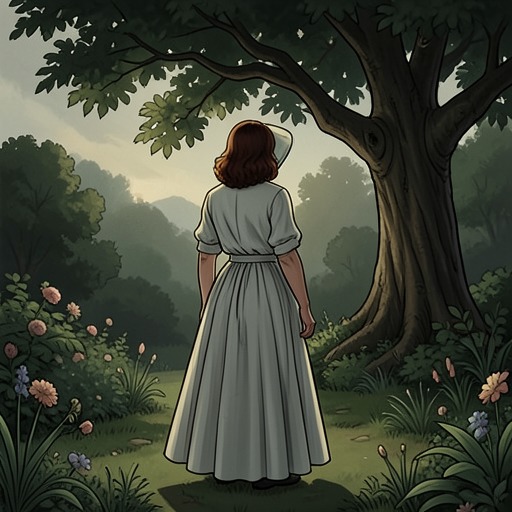
“The best remedy for those who are frightened, lonely or unhappy is to go outside”
Diary of Anne Frank“The best remedy for those who are frightened, lonely or unhappy is to go outside” expresses Anne Frank’s belief that contact with nature can console people under pressure. Written from the confinement of the Secret Annex, it is not a promise that suffering will disappear: Anne instead insists that the sky, nature, and God can still offer solace, while her reflections on her friend Hanneli Goslar reveal the sharp limits of her own safety and power to help.
The thought and its setting
Anne introduces the remedy as a general truth about fear, loneliness, and unhappiness, but grounds it in a particular experience of looking outward from the Annex. After watching Peter chop wood in the loft, she turns to the open window and the view across Amsterdam’s rooftops to a nearly invisible strip of blue on the horizon. The contrast between the confined interior and that distant sky gives the thought its force: going outside means entering a wider world of nature and solitude, even when ordinary freedom remains out of reach.
The passage describes more than a change of scenery. Anne says that being alone with the sky, nature, and God can restore a sense that things are as they should be and that people are meant to find happiness in nature’s beauty and simplicity. The remedy is inward as well as physical: attention to the natural world interrupts fear and sorrow with a sense of order and companionship beyond the crowded hiding place.
Nature, faith, and consolation
Anne develops the thought into a lasting conviction. As long as nature exists, she believes, it can provide comfort for every sorrow, whatever the circumstances. The confidence is striking because the circumstances are not temporary discomfort alone: Anne and the others are Jews in hiding, exposed to danger and cut off from ordinary life. Nature does not undo those conditions; it remains a source of solace within them.
Her account also joins observation of the natural world to religious reflection. Anne describes God alongside the sky and nature, and imagines that nature’s beauty and simplicity accord with a divine wish for human happiness. This is a personal expression of lived faith, not a simple report of settled religious observance. Earlier, she records that her mother pressed a German prayer book into her hands and that the prayers sounded beautiful but meant little to her. In later reflections, she nevertheless turns to God when thinking about suffering, the fate of the Jewish people, and the possibility of consolation. The diary preserves that tension rather than resolving it into a single religious position.
A conviction tested by suffering
Anne’s confidence in solace through nature coexists with an acute awareness of unequal fortune. When she imagines Hanneli Goslar before her, she sees a friend in helpless suffering and asks why she has been chosen to live while Hanneli may die. She regrets having misjudged and neglected her, recognizes that Hanneli was devoted to her friend, and wishes she could take her in and make amends if she survives the war. The earlier belief that nature can comfort all who suffer thus does not make Anne indifferent to suffering she cannot relieve.
That same tension appears in her reflections on Jewish identity. Anne asks who has set Jews apart and made them suffer, while also holding to the belief that God may lift them up again. She writes that Jews cannot simply become Dutch or English, but will remain Jews; the hope of surviving and being recognized as people again sits beside an insistence on the continuity of Jewish identity. Against this larger fear and uncertainty, nature’s consolation is real but limited: it offers a place for inward relief, not an escape from persecution or a guarantee of survival.
Significance in the diary
The expression’s enduring significance comes from the scale of its claim and the vulnerability of the voice that makes it. Anne moves from a glimpse of blue sky over Amsterdam to a broad assurance that nature can console every sorrow, then elsewhere confronts the anguish of knowing that another person may not be spared. The diary holds both statements together. Nature is not a cure for oppression; it is a source of comfort that Anne can still affirm while writing from confinement, fear, and uncertainty.